AFTERLIFE
Conway's Life with a time machine: scrub history, fork alternate futures, sculpt time in 3D, and play in deterministic lockstep across tabs.
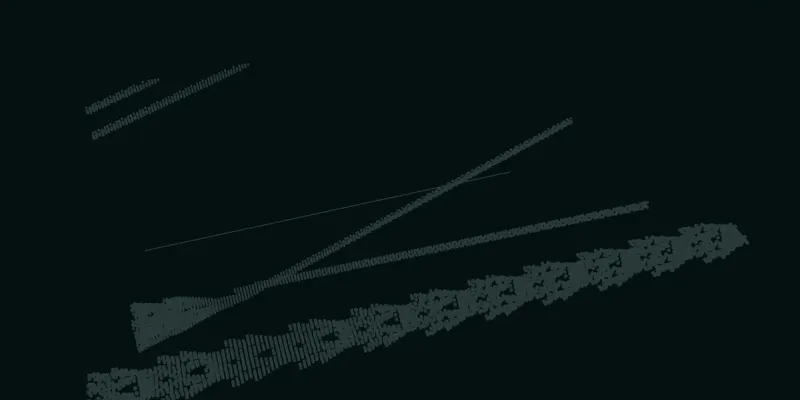
Every future leaves a trace.
Everyone knows Conway's Game of Life. AFTERLIFE runs exactly that rule, standard B3/S23 on a 256×160 torus, but it doesn't care how fast it can go. It asks what happens if you touch one cell. The whole interface is organised around time: the world's full history sits in a ribbon along the bottom, you can scrub it in either direction, and editing the past forks a new future instead of overwriting the old one. Its own guide puts it best: "It's not a simulator. It's an observatory with a time machine."
It runs in the browser with no account and no install. Open it and touch the world.
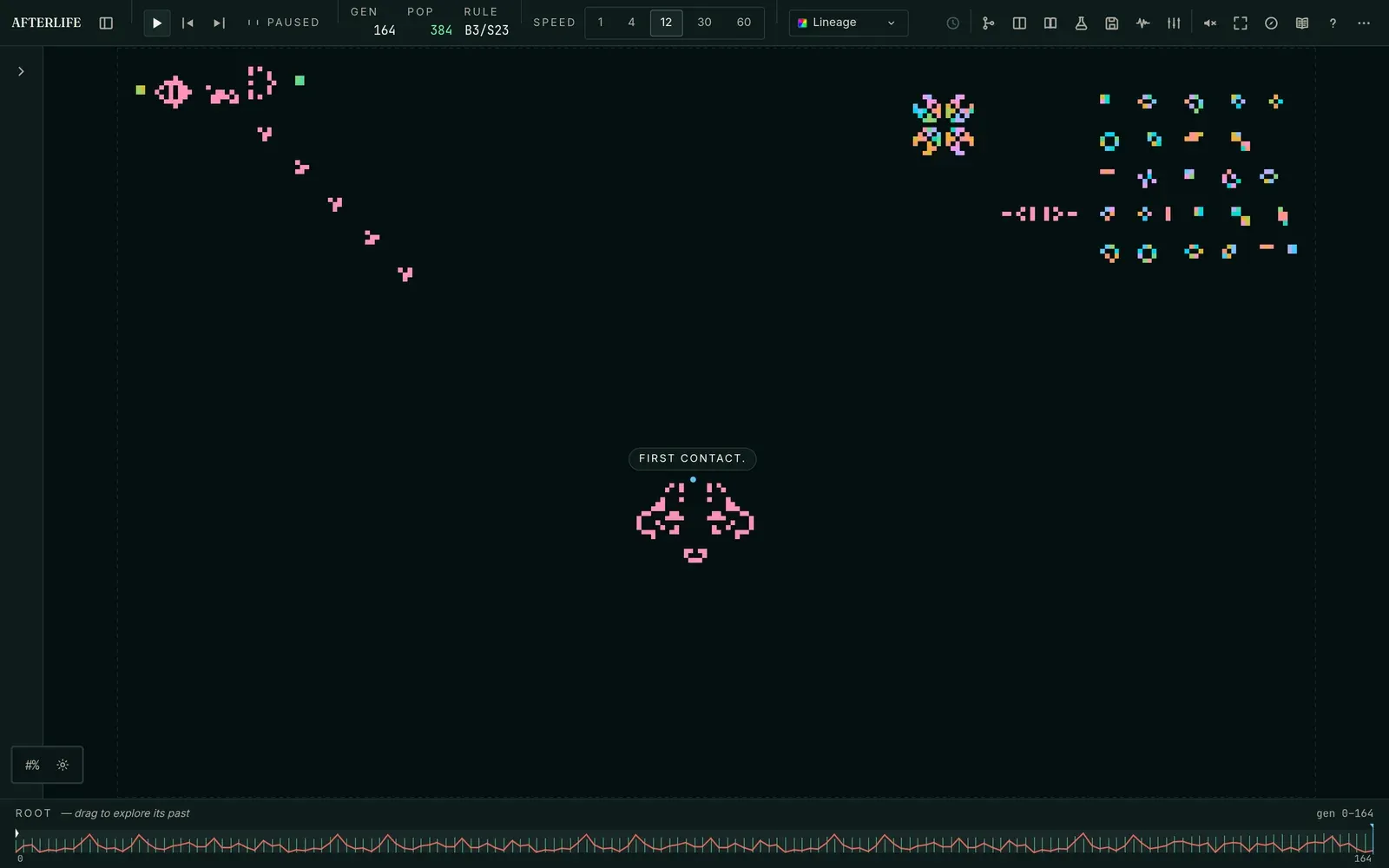
The opening scene a few seconds in, captured from the live app. The two populations meet at generation 123, and the app marks the spot.
Time as a material
The history ribbon is the real record, not a recording. AFTERLIFE keeps a keyframe every 64 generations plus the edits you made, so jumping to any generation restores the nearest keyframe and replays forward bit-exactly. Generation 4,000 really is generation 4,000.
Edit a cell in the past and the future forks. The original timeline keeps going on its own branch (up to eight branches, least recently used evicted first, except ones you've named), and a compare view diffs the two cell by cell. Branching only copies pointers to the parent's keyframes, so a "what if" is cheap. The "One Cell" experiment makes the point: flip one cell in the opening scene and the world is dead by generation 54, where the untouched timeline grows to a population of 221.
Then there's the Time Sculpture. Select a stretch of the world and AFTERLIFE lifts its recorded generations into a 3D stack you can orbit and slice. Time becomes the third axis, so still lifes turn into columns and gliders turn into inclined beams.
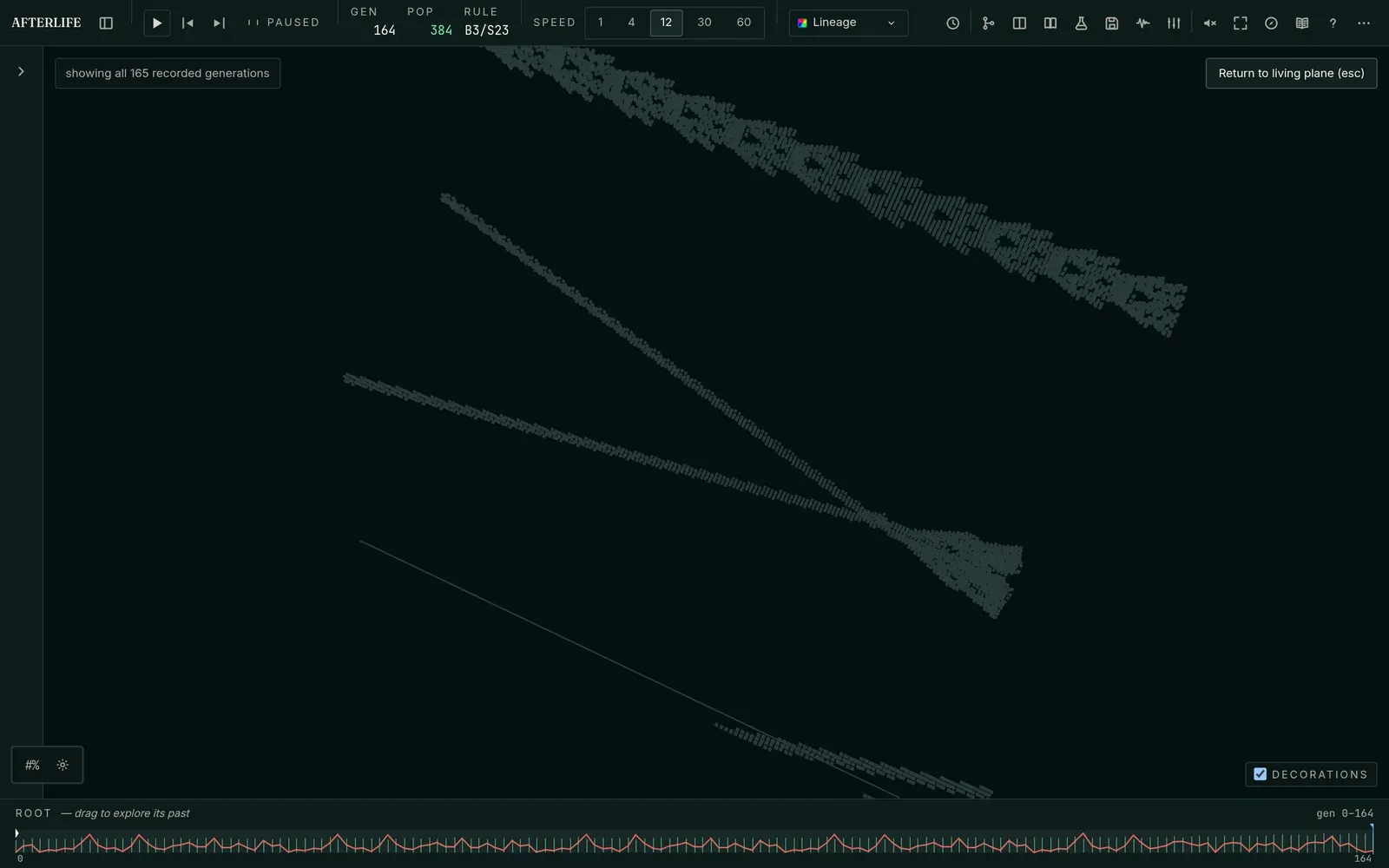
Captured from the live app: the same 165 generations as the image at the top of the page, orbited to the side.
The rest of the observatory
- Lineage colour. In the default lens, a newborn cell takes the circular mean of its three parents' hues, so populations visibly interbreed where they meet. Colour rides along after the alive-or-dead decision, and a test poisons the colour state to prove the live cells stay byte-identical. There are eight lenses in all.
- Acid Art. A glyph mode that draws cells as characters from a JetBrains Mono atlas, modulated by noise, plasma, an image, a video or your webcam.
- Rules and specimens. Ten Life-like rule presets plus any custom B/S rulestring, RLE import, a Field Guide that recognises specimens as they appear, and three scored experiments.
- Sound. A generative WebAudio soundscape driven by how much the world is changing, so it decays to real silence when the world is still, plus Web MIDI out with a panic button.
- Export. GIF, WebM, PNG and WAV, rendered from an independent offline replay rather than the live screen, so frame pacing is exact. The GIF encoder (median-cut quantiser, LZW and GIF89a writer) is hand-written and checked against Chromium's own decoder.
Multiplayer with no server
Multiplayer is opt-in and works across browser tabs today. Each edit is stamped 12 generations ahead and applied by every peer in the same (targetGen, peerId, seq) order, so nobody is authoritative and every world stays identical. Peers on different rules refuse to connect. If an edit hasn't arrived, the simulation stalls rather than guesses, and every 64 generations peers compare hashes of the world to catch any drift. A WebSocket transport is written, but no relay is deployed, so it's tabs-only for now.
How it was built
AFTERLIFE went from first commit to v1.3.0 in about three days (7 to 9 September 2026): 68 commits and four releases. It was built by a parallel multi-agent harness, and the repo still has the append-only integration log the agents coordinated through.
The docs only claim what was actually run. The opening encounter was found by simulation search. No puffer ships, because a search of more than 2,600 candidates didn't turn up one that verified cleanly. One rule preset was dropped because its advertised behaviour didn't reproduce. When Tailwind's production build quietly turned every colour lens white, the fix came with a Playwright project that builds for real and checks the canvas pixels. The README reports hundreds of unit tests and over a hundred Playwright specs, at desktop and phone sizes.
The Time Sculpture needs real WebGL, and it renders dark on software-only graphics.
Play it live, read the guide and wiki, or browse the source on GitHub.