Shoal
Agent-first structured shell in Rust: typed values and dot-chains instead of pipes, hash-locked tool resolution, OS sandboxing, and an MCP agent surface.
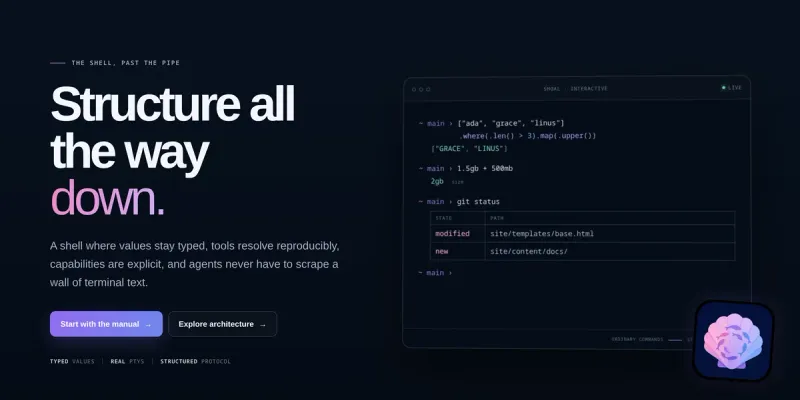
Structure all the way down.
Shoal is a shell where command output stays typed, so neither a human nor an AI agent has to scrape terminal text to find out what happened. Commands and expressions produce values (tables, sizes, durations, paths, outcomes) instead of bytes. It's a 22-crate Rust workspace, built in an intense sprint in July 2026.
A real session: a typed ls table, a sort and map, 1.5gb + 500mb coming out as 2gb, a typed function called like a command, and what happens when you reach for a pipe.
Past the pipe
Unix composes programs by agreeing on bytes. Shoal keeps the composition and gives data its shape back, with method chains instead of pipes:
let large = (ls .)
  .where(.type == "file")
  .where(.size > 10mb)
  .sort_by(.size)
  .reverse()
large.map({ name: .name, megabytes: .size / 1mb })
There is no | operator at all. Type one and the shell teaches you its model instead of silently accepting bash:
<repl>:1:4: parse error: shoal has no pipe operator
  ls | grep foo
     ^
  hint: data composes with `.`; raw byte plumbing is `.feed(cmd)`; verbatim POSIX lives in `sh { … }`
$VAR, heredocs and numbered redirects get the same treatment, each pointing at the Shoal equivalent, and real POSIX is still there behind an explicit sh { … }. Bare words are typed as they're parsed (./src is a path, *.rs a glob, 1mb a size), typed functions double as commands with flags, and a command used as a value captures an outcome with its status, structured stdout, stderr, duration and pid.
Reproducible tools and explicit capabilities
Reef resolves tools through project and user scopes instead of ambient PATH. A lockfile records each executable's blake3 content hash, drift is detected, and which shows the whole resolution chain. PATH becomes an output: for legacy programs that search it themselves, Shoal builds a content-addressed view of symlinks.
Leash is a per-principal capability policy in TOML covering network, process spawning, environment, secrets and filesystem globs. The effects of a command are planned before anything runs, approval and apply are separate steps, and filesystem grants are enforced by the OS through Landlock on Linux or Seatbelt on macOS. The caveats are the project's own: on main only the filesystem is OS-enforced (network rules are checked by policy only), and one kernel isn't a multi-tenant boundary.
Built for agents
A long-lived kernel serves named sessions over JSON-RPC, and an MCP facade gives agents 13 tools: execute, plan, approve and apply, query the journal, and drive interactive programs on a real PTY, getting back a rendered screen grid instead of raw ANSI. Large results come back as a bounded preview plus a fetchable shoal:// reference. A Claude Code plugin wires it all up in one step. Every execution is recorded in a SQLite journal with a blake3 content-addressed store, and undo replays a typed inverse only when one was recorded, refusing stale state rather than guessing.
How it's engineered
- A conformance corpus of 1,310 cases in 77 suites is the executable language spec.
- Fuzz targets cover the lexer, the parser and the wire protocol framing.
- 49 declarative adapters turn the output of existing CLIs like git, docker, kubectl and jq into typed tables.
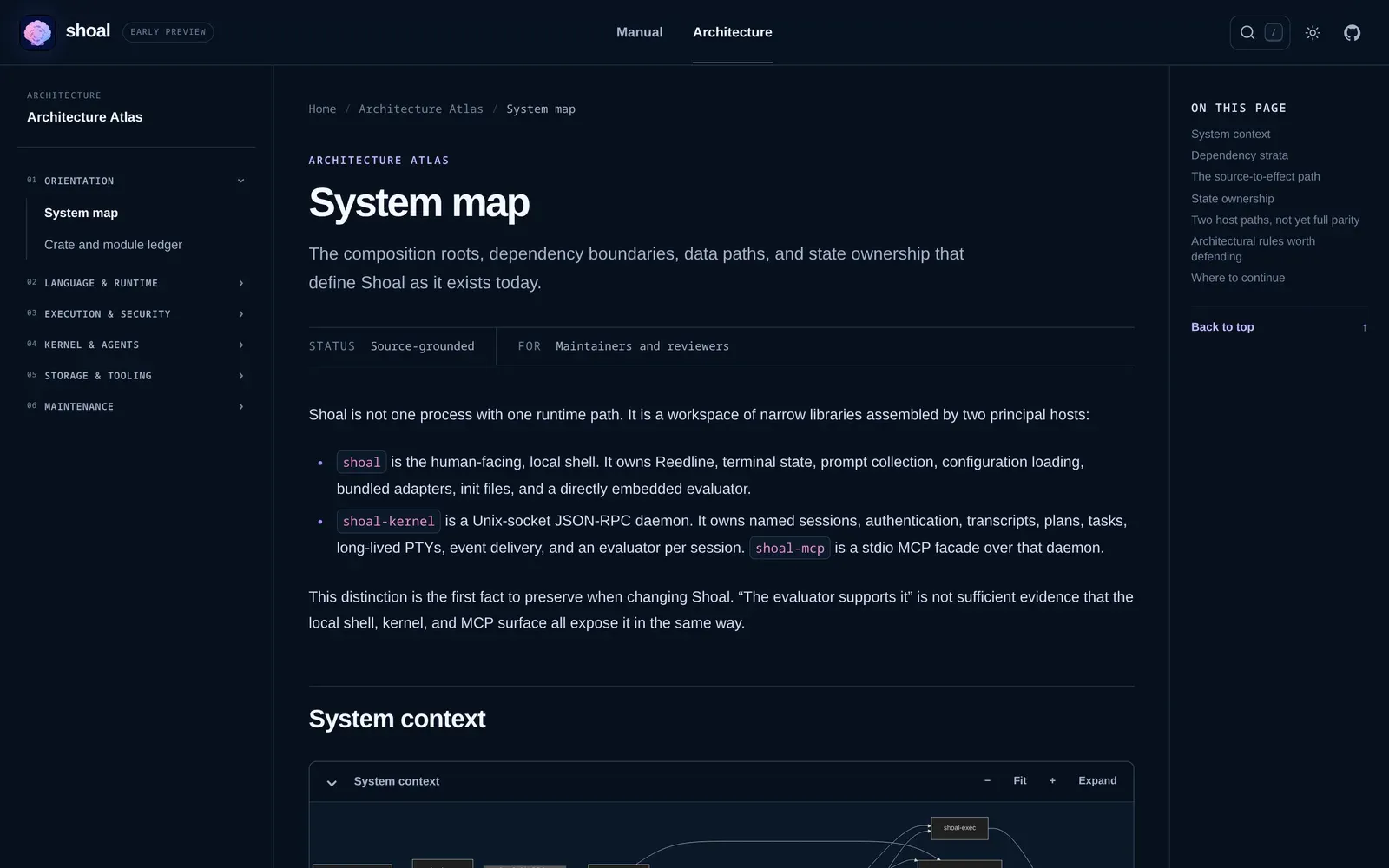
- The docs site is both a user manual and an architecture atlas with dozens of diagrams.
Status
Shoal is a pre-release preview, in the project's own words "a substantial, working preview", not a login shell you'd switch to tomorrow. It's Unix-only, has no releases (you build it from source), and has been quiet since July 2026. It also audited itself: the status page lists two open P0 findings on main, unauthenticated plan approval and plan-reference collisions. Fixes exist on an unmerged hardening branch but haven't shipped. Dual-licensed MIT or Apache-2.0.
Shoal sits next to Lumen and puml as part of a small run of Rust language and runtime projects: typed structure over text, parsers and compilers, and output agents can actually consume.