Git Why
git blame tells you who changed the code; git why finds the commit that explains it. Local hybrid search over Git history, benchmarked honestly.
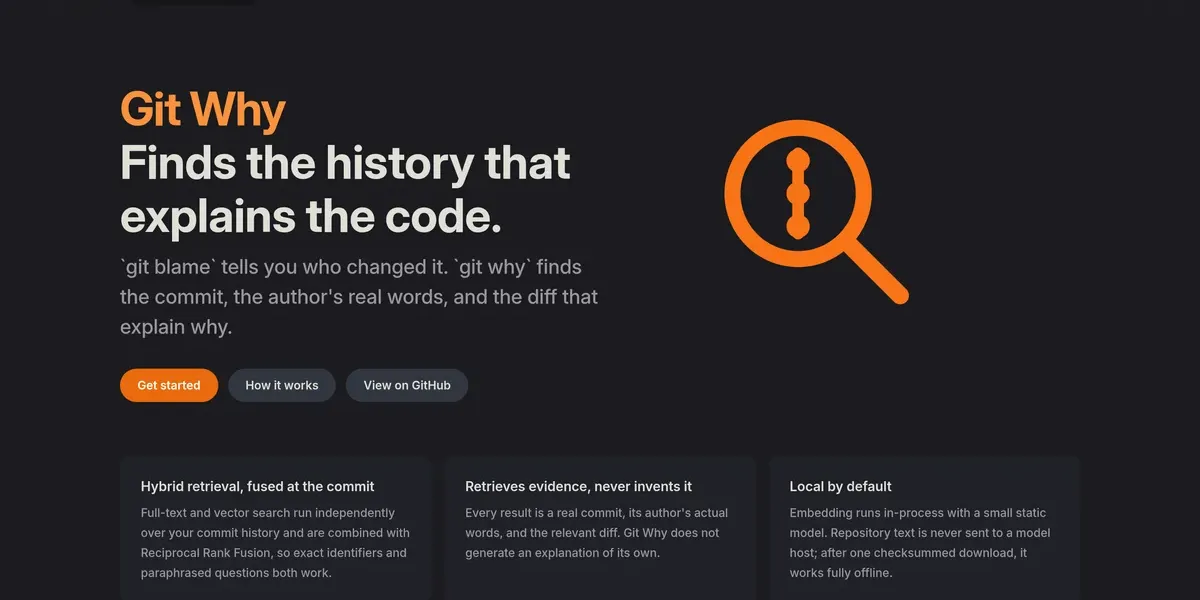
git blame tells you who changed the code. git why finds the history that explains it.
You remember what went wrong, not what the fix was called, so git log --grep can't find it. git why "<question in your own words>" searches a repository's history by meaning as well as by keyword, and returns the actual commit, the author's own words and the relevant diff. It deliberately doesn't generate an explanation.
From the README: you ask about "reconnecting subscribed twice", and it finds the commit titled "Stop duplicate subscriptions after reconnect". The two share almost no words, and that mismatch is the whole idea.
A real run of git why, built from source, against a small made-up repository. The question says "wait" and the top result's title says "back off"; it is the commit whose message explains the delay, shown with its diff. The second result is the earlier commit that added retries at all.
How it works
Every reachable commit becomes a record of its message, paths and a bounded slice of diff evidence. A full-text index and a small static embedding model (Model2Vec's potion-code-16M-v2, 256 dimensions) each retrieve candidates, Reciprocal Rank Fusion merges them, and a lexical-overlap reranker reorders the top. It all runs locally, and the index lives under the Git common directory, so every worktree shares one index. An optional warm daemon cuts a query on curl's 30,000-commit history from 569 ms to 286 ms, and if it's unreachable the query just runs directly.
Measured, not claimed
The benchmark is built so keyword search can't win by construction: 174 questions derived from six pinned repos (curl, redis, requests, ripgrep, caddy and zod), each thrown out if git log --grep or git log -S could answer it from the question's own words. On those, git why gets the right commit in its top five 37.4% of the time. The README says it plainly: it's wrong most of the time, and it still beats every Git-native strategy on questions they can't answer.
It also publishes where it loses. On cross-file causal questions, git log -S scores 0.950 Hit@10 against git why's 0.350. A decisions log records eight measured ideas for improving ranking: one shipped (+26% MRR on a held-out half), seven were rejected. Every number in the README is generated from raw benchmark data, and CI fails if one is edited by hand.
For agents, including when not to use it
Git Why ships an MCP server plus Claude Code and OpenCode plugins. The plugin's skill tells an agent when to reach for something else: if it can't name the term, use git why; if it can name the symbol, use git log -S. A paired agent benchmark is reported in the README as mixed and not significant, and the page isn't going to pretend otherwise.
Status
Built from 9 to 11 September 2026: 163 commits on main, Apache-2.0. Install it from npm with npm install -g @alliecatowo/git-why (v0.2.0, Node 22.12 or later), or with brew install alliecatowo/tap/git-why, which gives you git why plus a git-why-mcp server for agents. The server is also listed in the official MCP registry as io.github.alliecatowo/git-why. The docs site has recorded sessions against real repositories if you'd rather just watch. v0.2.0 (4 October 2026) is mostly a hardening release. Three integration tests that had been failing were fixed properly: fixtures now isolate the global Git config, and the non-UTF-8 path and broken-pipe cases are covered. CI gained network-free integration and Node-engine-floor jobs. The MCP server's working directory is now confined to the server's own directory or the paths in GIT_WHY_MCP_ROOTS, which is a behaviour change if you pointed it elsewhere. The extraction and ranking policy versions were bumped, so an existing index rebuilds once on first use. The release workflow also had to be re-run once, because npm's CDN served 404s for a fresh tarball for over ten minutes; the wait is now 15 minutes. The new CI jobs aren't yet required checks on main.
The benchmark report and decisions log are worth a read.