rssd
A file-based RSS daemon: feeds become a tree of atomically written XML entries with revision history, a tail-able JSONL event log, and a vim-style TUI.
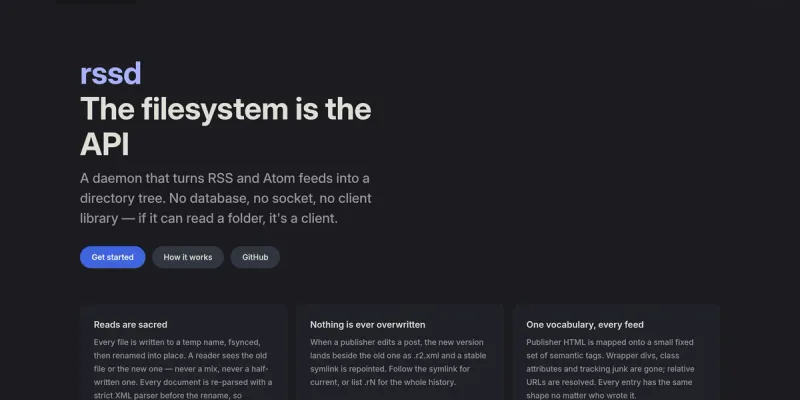
The filesystem is the API.
rssd watches a folder of subscription files, polls the feeds, and writes every entry as its own XML file in a per-feed folder. There's no database, no socket and no client library. Anything that can read a directory is a client: grep, find, tail -F, your editor. The bundled reader, rss, plays by the same rules and has no private channel to the daemon. That's why there are two binaries: rssd writes the tree, rss only reads it.
demo/
├── feeds.d/     you write
├── store/       rssd writes
│   └── rust-blog/entries/
│       ├── …update.xml
│       ├── …update.r1.xml
│       └── …update.r2.xml
└── var/events.jsonl
Adapted from the README's example tree: you write feeds.d/, the daemon writes store/, each revision of an entry is its own file with the plain name pointing at the newest, and var/events.jsonl is there to tail -F.
Three invariants
- Writes are atomic. Every file is written to a temp name in the same directory, fsynced, re-parsed with a strict XML parser, then renamed into place. A reader never sees half a file, and malformed XML never lands. A
SIGKILLcan only leave a temp file behind, which is swept on the next start. - The tree is the truth. Each entry carries its own ID and content hash, so
rm -rf var/is fully recoverable by rescanning, and the rebuild writes nothing. - Files only change when content does, so
mtimemeans what you'd expect.
When a publisher edits a post, each version is kept as its own .rN.xml file, the plain name links to the newest, and rss diff compares them. Changes are detected by hashing the rendered semantic content rather than raw bytes, so a reordered attribute or a rotating ad token can't fake a revision. Publisher HTML is mapped onto a small fixed XML vocabulary, and each entry records where its body came from; rssd never makes content up.
A polite client with an honest log
It uses conditional GET, honours Cache-Control and Retry-After, and backs off per feed with jitter. Full-text fetching is opt-in per subscription. The event log's guarantee is carefully worded: if you see entry.new, the file exists and is complete. The converse isn't promised, so consumers reconcile when the daemon starts.
The rss reader addresses entries by ID prefix, position or path, and rss tui is a modal three-pane reader with hjkl, /, and :set working the way vim taught you.
How it was built
Spec first, then code, in one evening on 15 September 2026: a 587-line spec and nine commits. Byte-exact captures of seven real feeds (including the GitHub blog, go.dev, Hacker News and xkcd) plus a local fixture server mean the whole thing runs with no network. The README counts about 300 tests. It's a small, sharp design exercise rather than a daily-driver reader, and it isn't on PyPI (the rssd name there belongs to someone else), so run it from source with uv. Docs, spec, MIT.